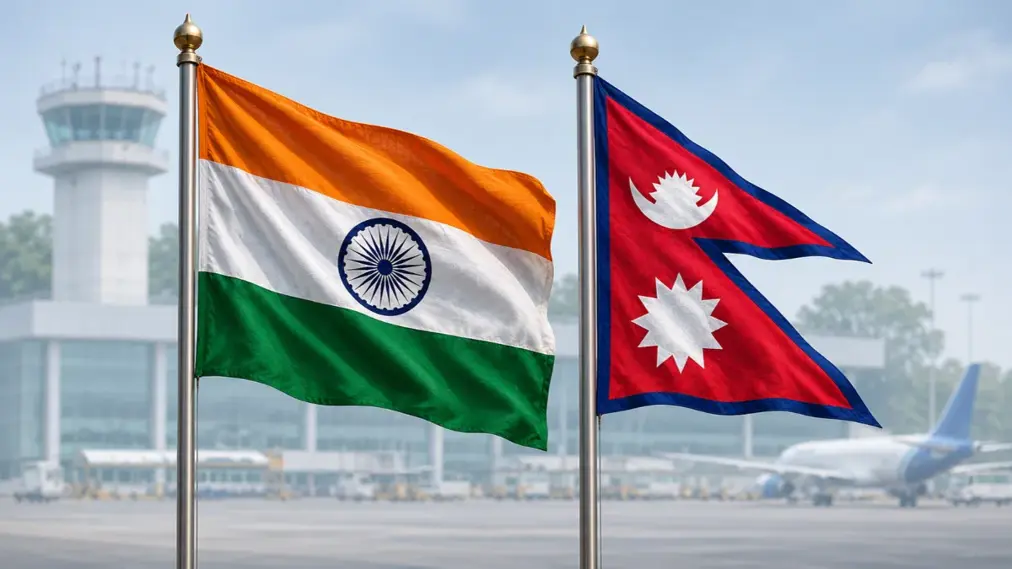
India’s reported request to use Nepal’s airspace for civilian flights operating to and from Bagdogra Airport in West Bengal has drawn attention to the strategic significance of the Siliguri Corridor, with South Asia expert Sukh Deo Muni suggesting that New Delhi was testing Kathmandu’s willingness to accommodate India’s security concerns regarding China.
The assessment comes amid negotiations between India and Nepal over reciprocal air connectivity, even as Indian sources have rejected reports that New Delhi sought permission for military aircraft to use Nepali airspace near Bagdogra.
Notably, Bagdogra Airport operates as a civil enclave within an Indian Air Force station, close to the India-Nepal border.
Muni, Professor Emeritus at Jawaharlal Nehru University’s School of International Studies and a former member of the Executive Council of the Institute for Defence Studies and Analyses (IDSA), linked the reported Indian request to wider geopolitical considerations.
“India’s demand for Nepali air space for its Bagdogra flights was aimed to test Nepal’ response to India’s security sensitivity in relation to China. Nepal does not seem to be ready to cooperate in that respect at least as yet,” Muni wrote on X.
Why does India want access to Nepal’s airspace for Bagdogra flights?
Bagdogra Airport’s proximity to the international border makes access to additional airspace potentially beneficial for aircraft operating in the vicinity.
According to a November 17 report in The Kathmandu Post, India has sought a near-border operation agreement with Nepal for Bagdogra Airport, while Kathmandu has requested a similar arrangement for Gautam Buddha International Airport at Bhairahawa.
Nepali aviation ministry officials subsequently explained that such an arrangement could provide aircraft with additional protected operating space during adverse weather, unsuccessful landing approaches and other contingencies.
What does international aviation law say?
Under Article 1 of the 1944 Convention on International Civil Aviation, commonly known as the Chicago Convention, every country has exclusive sovereignty over the airspace above its territory.
The Convention distinguishes between civil aircraft and state aircraft, with military, customs and police aircraft falling into the latter category.
Article 3(c) requires state aircraft to obtain authorisation before flying over or landing in another contracting state’s territory.
An arrangement covering civilian aviation would not, by itself, confer permission for military aircraft to use the same airspace.
Where did the military aircraft controversy originate?
On November 22, The Kathmandu Post, citing an unnamed Nepali official involved in the negotiations, reported that India had also proposed permitting its military aircraft to use the Bagdogra entry point.
The official said Nepal was prepared to consider civilian access but not military aircraft operations.
Indian sources subsequently rejected the claim.
“There is no such proposal,” sources told ANI on November 22, dismissing reports that India had sought permission for military aircraft to use the entry point.
Why the Siliguri Corridor is strategically important
Bagdogra Airport is located in the Siliguri Corridor, commonly referred to as India’s ‘Chicken’s Neck’, which connects the country’s northeastern states with the rest of India.
Approximately 22 km wide at its narrowest point, the corridor is situated in a region adjoining Nepal, Bhutan and Bangladesh, with China lying further north.
Bagdogra’s significance extends beyond commercial aviation because the airport operates as a civil enclave within the Indian Air Force’s Bagdogra Air Force Station.
What does Nepal want in return?
The reported Indian proposal emerged during discussions over Kathmandu’s longstanding demand for additional air routes through Indian airspace to facilitate international operations at Nepal’s regional airports.
According to IANS, two officials at Nepal’s Ministry of Culture, Tourism and Civil Aviation said the Bagdogra proposal was made during a Director General-level meeting between the aviation regulators of the two countries.
A delegation led by Mukesh Dangol, Director General of the Civil Aviation Authority of Nepal (CAAN), had visited New Delhi to discuss additional air routes that Kathmandu has been seeking for more than a decade.
The Nepali officials said India had proposed reciprocal airspace access as part of a package, while Kathmandu sought additional time to examine the request.
Nepali media reports also indicated that India had sought access to airspace near Raxaul in Bihar, with Kathmandu requesting further technical information on the proposal.
What did the Modi-Shah talks achieve?
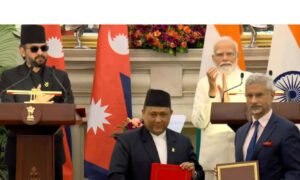
Following bilateral talks between Prime Minister Narendra Modi and Nepal Prime Minister Balendra Shah on November 23, India and Nepal announced an agreement to make the existing one-way B345 Kathmandu-Bhairahawa-Lucknow air route bidirectional.
The joint press release confirmed that further technical consultations would be held to finalise the arrangement and address other outstanding civil aviation proposals from both countries.
The agreement could help improve international flight connectivity at Nepal’s regional airports, subject to the operational arrangements agreed upon by the two sides.
Source: MSN